
- Campaigners from United for Warm Homes Kirklees gathered outside MP’s offices across Kirklees to hand in the damning new report from Sir Michael Marmot’s Institute of Health Equity
- The new analysis finds 9.6 million UK households are living in heat-leaking, poorly insulated homes and have incomes below the minimum required for an acceptable standard of living
- In Kirklees alone, an average of 64% houses are poorly insulated (below EPC rating C), putting people at risk of the negative health impacts of cold homes
- Tens of billions of pounds a year in costs to the NHS and lost productivity, would be saved by investing £6bn annually in a national insulation programme – needed alongside urgent action to reduce hardship and address high fuel costs
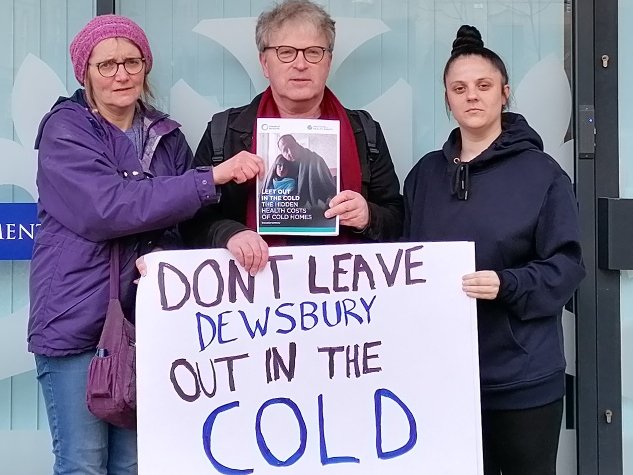
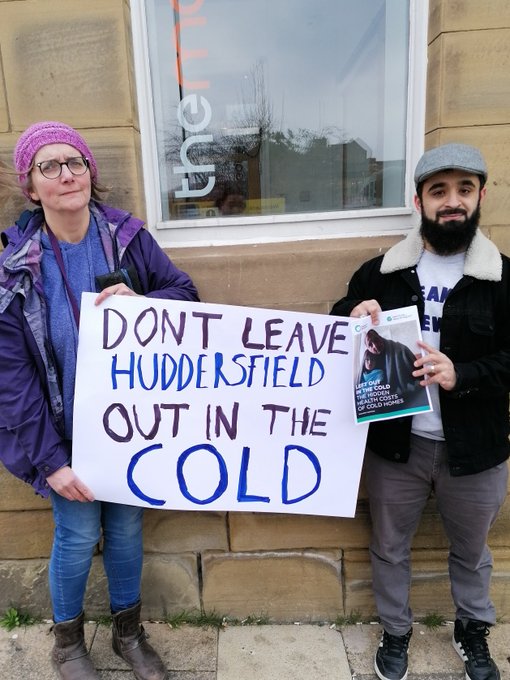
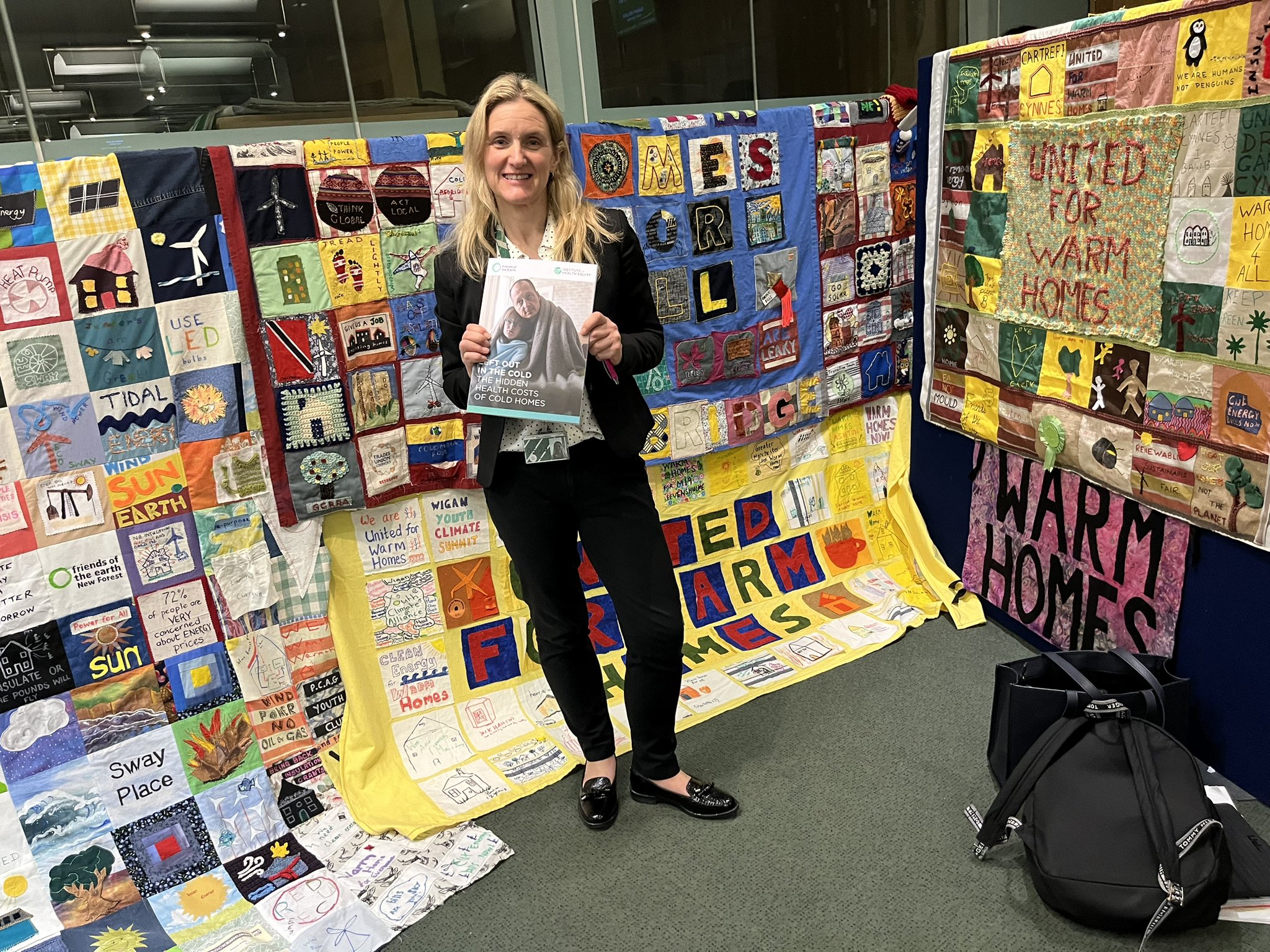
United for Warm Homes supporters visited the MP offices of Mark Eastwood (MP for Dewsbury), Jason McCartney (MP for Colne Valley), and Barry Sheerman (MP for Huddersfield) on Friday 8 March 2024, to hand in new research on the serious health impacts caused by Britain’s cold homes. Kim Leadbeater (MP for Batley & Spen) had already attended the launch of the report at Westminster
The hand-in, staged by Huddersfield Friends of the Earth, saw campaigners urging local MPs to ensure that people across Kirklees are not left out in the cold, as they condemned the total lack of action to address the country’s woefully inadequate, heat-leaking homes. The group is one of more than 260 across the country campaigning for the solutions that will keep homes warmer and ensure they don’t cost the earth.
The damning new report ‘Left out in the cold: the hidden health costs of Britain’s cold homes’, produced by Sir Michael Marmot’s UCL Institute of Health Equity on behalf of Friends of the Earth and handed in by the group, has found that many millions of households are now at the point of crisis due to the lack of meaningful action on cold homes over the last decade.
This failure to upgrade the UK’s energy inefficient housing stock, alongside years of wage stagnation, high energy prices, exorbitant living costs and unaffordable housing, has left the hope of a warm and healthy home far out of grasp for too many.
The analysis finds a staggering 9.6 million UK households[1] are living in poorly insulated homes with incomes below the minimum level at which an acceptable standard of living is affordable, meaning that finding enough money to pay for decent housing, enough heating and the essentials of life will be out of reach for most – at stark detriment to their health and wellbeing.
According to the latest health evidence, adults that experience prolonged cold temperatures at home double their risk of developing new mental health conditions[2]. Meanwhile, an alarming 1 in 4 (28%) children that live in cold homes are at risk of multiple mental health symptoms, such as anxiety and depression. Physical discomfort from the cold, financial stress, social isolation and loneliness are all thought to contribute to declining mental health.
Cold homes are also associated with negative health outcomes more widely, including heightened risk of heart attacks, impairment in children’s lung and brain development and respiratory problems, which can be exacerbated by damp and mould.
Across Kirklees, 118,197 homes are poorly insulated, defined as those below EPC rating C [3]. This means 64% of homes across the constituency are in need of vital upgrades to ensure people aren’t facing higher than necessary energy bills and the negative health outcomes associated with cold and damp environments.
Marginalised and vulnerable communities, including those with pre-existing health conditions, people of colour, older people, young children and those on low incomes, are disproportionately impacted by cold homes.
Through costs incurred to the NHS, mental health services, care costs and the lost economic contributions of those who develop illness associated with cold homes, researchers estimate cold homes are costing the UK economy tens of billions of pounds per year.
That’s why campaigners are calling for investment of at least £6bn a year to upgrade UK homes, which would go some way to alleviating the high number of people experiencing cold-related hardship, while also saving the economy billions each year in avoided health, climate, and economic productivity costs.
Chayley Collis, from the United for Warm Homes Kirklees campaign said:
“Something’s clearly not right when nearly 10 million households are living in substandard, freezing homes that are making them sick. The failure to upgrade the UK’s housing stock has left too many exposed to the serious physical and mental health impacts of cold homes, while costing our economy and the NHS billions each year.
“No one in Kirklees deserves to be left out in the cold. By urgently investing in a national home insulation scheme, the government could ensure everyone has access to a warm and safe home. This would not only slash people’s energy bills, but also reduce the planet-warming emissions that come from heating our homes.
“That’s why we’re campaigning as part of United for Warm Homes, and sharing this shocking new evidence with our local MPs. We urge them, and all political parties, to commit to urgent action to upgrade our homes as we head towards the general election. We know this is a critical issue for people in across Kirklees – we want to see a level of ambition a crisis of this scale requires.”
Professor Sir Michael Marmot, director of the UCL Institute of Health Equity, said:
“Cold homes are a public health hazard: those living in them have much higher risk of developing poor physical and mental health and this is adding burden onto an already overstretched NHS and contributing to poor productivity. We need urgent action to address poverty, the cost of fuel and to insulate the homes of the poorest, not just because the government has a moral duty to look after the health of its population, but also, frankly, because it makes economic sense too.”
ENDS
Notes
[1] An analysis of detailed data tables within the government’s English Housing Survey enabled researchers to calculate the number of homes with incomes below the Joseph Rowntree Foundation’s Minimum Income Standard (which varies between size of households) in England and the number of these that had poor insulation levels (EPC D, E and F). The figure was extrapolated to cover other UK nations to give a UK-wide estimate.
[2] Section 1.3 of the main report provides details of recent studies in the effect of cold homes on mental health.
[3] Not all of these homes are below the Joseph Rowntree Foundation Minimum Income Standard.
[4] The full report ‘Left out in the cold: the hidden health costs of Britain’s cold homes’ can be viewed here.
United for Warm Homes Kirklees is coordinated by Huddersfield Friends of the Earth, with a range of partners including The Welcome Centre, Huddersfield Trade Union Council and Huddersfield Hindu Temple. The campaign has held stalls, rallies and events across Kirklees to grow awareness for the campaign.
United for Warm Homes: United for Warm Homes is a growing grassroots movement, powered by Friends of the Earth, to secure the national change that guarantees everyone benefits from a warm home that doesn’t cost the earth. Neighbourhood by neighbourhood, people are coming together to support each other through the cost-of-living crisis and build a diverse coalition of community groups that is too powerful to ignore.
About Professor Sir Michael Marmot: He is Professor of Epidemiology at University College London, Director of the UCL Institute of Health Equity, and Past President of the World Medical Association. He is the author of The Health Gap: the challenge of an unequal world (Bloomsbury: 2015) and Status Syndrome: how your place on the social gradient directly affects your health (Bloomsbury: 2004). Professor Marmot holds the Harvard Lown Professorship for 2014-2017 and is the recipient of the Prince Mahidol Award for Public Health 2015. He has been awarded honorary doctorates from 21 universities. In 2021 Professor Marmot received BMJ’s Outstanding Contribution to Health award. Professor Marmot has led research groups on health inequalities for over 40 years.
About the UCL Institute of Health Equity: The IHE is confident enough to conclude that we have the evidence on what needs to be done to advance health equity, as laid out in our 2010 Marmot Review. The UCL Institute of Health Equity works in local partnerships nationally and globally to influence the delivery of interventions to ensure they incorporate action on health, social and economic inequalities. Organisations with which the IHE works include business, city authorities, voluntary sector, local government and healthcare services.
 Huddersfield Friends of the Earth